
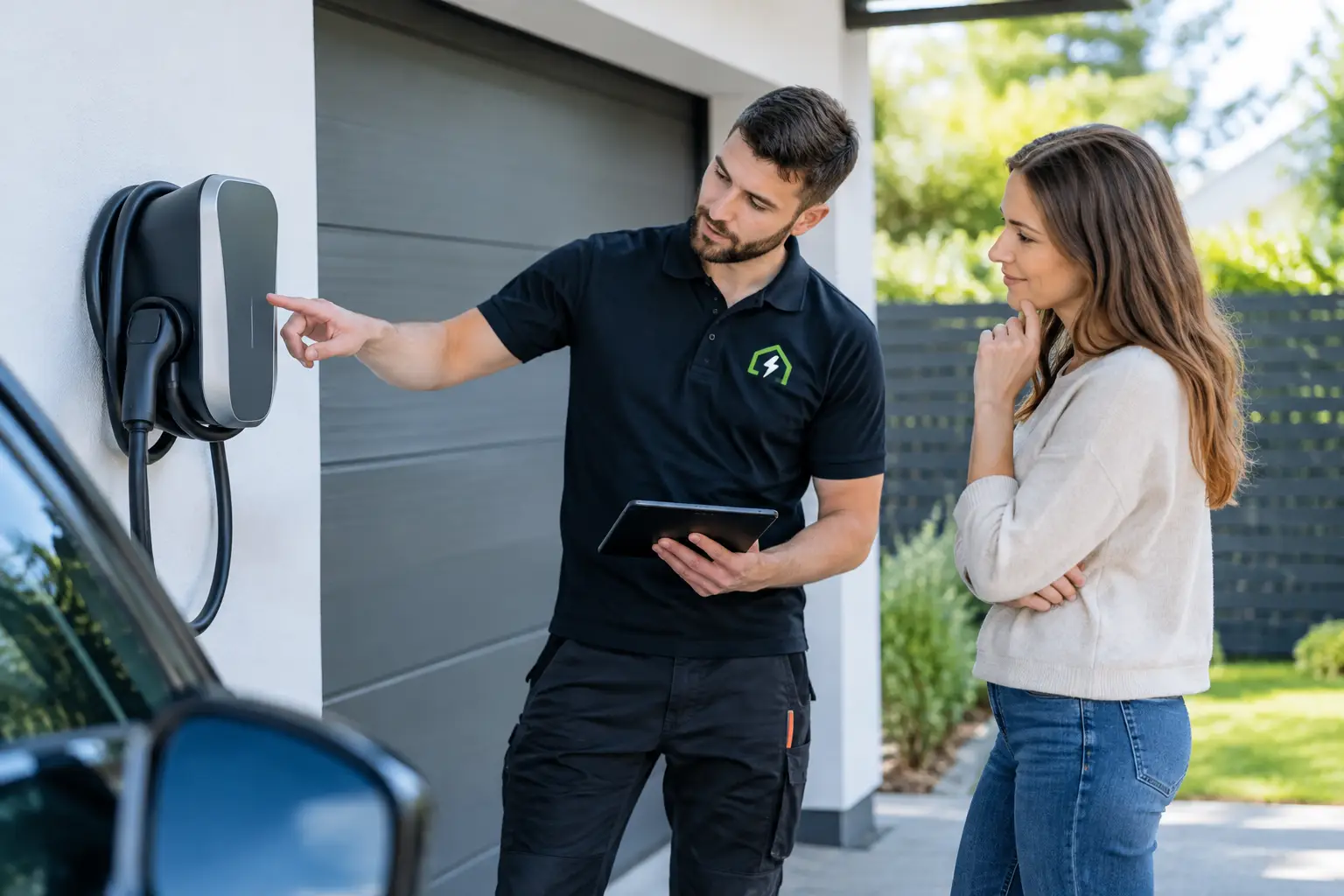
If you have off-street parking, the answer to “can I install an EV charger at home” is usually yes. The right installation, however, depends on more than having a driveway and a new electric car. Your electrical supply, consumer unit, cable route, parking arrangement and property type all need checking before work begins.
A dedicated home chargepoint is normally safer, faster and more convenient than relying on a standard three-pin socket. It also gives you a properly designed circuit, suitable protection and the certification needed to show the work has been completed correctly.
Can I install an EV charger at home?
Most homeowners in Bristol, Bath and Newport can install an EV charger at home where they have a private driveway, garage or allocated parking bay close enough to the property. A qualified electrician will assess whether the existing installation can safely support it and recommend a charger and cable route that suit how you park.
The simplest jobs are often properties with a modern consumer unit, spare capacity and a parking space beside the house. The charger can be mounted on an external wall or a suitable post, with the cable run neatly from the consumer unit to the chargepoint.
It becomes more involved where the parking space is some distance away, the cable would need to cross shared land, or the consumer unit is old or already heavily loaded. That does not automatically rule out a charger. It simply means the design may need additional work, such as a consumer unit upgrade, load management or a longer underground cable route.
Start with your parking and cable route
A home charger needs a practical, safe place to connect to the vehicle. Ideally, the chargepoint is positioned so the lead reaches the charging port without trailing across a pavement, public footpath or shared access route. Cables across public areas create a trip hazard and may require permissions that are not straightforward to obtain.
For a driveway, the charger may be fixed to the front or side of the property. In a garage, it can often be installed internally, provided there is a suitable route for the vehicle and the equipment is protected from accidental damage. Detached garages, garden offices and parking areas may need a new supply cable from the house.
Think about how you will park day to day, not just where the car happens to be when the charger is installed. Charging leads should not be stretched tight, trapped under gates or regularly driven over. A site survey helps identify the cleanest route before any drilling or excavation is planned.
Your consumer unit and electrical supply matter
An EV charger is a high-demand electrical appliance. Many domestic units charge at up to 7 kW, which is considerably more than typical household plug-in equipment. For that reason, it should be supplied by a dedicated circuit designed for the charger, rather than added to an existing socket circuit.
The electrician will check the condition and capacity of the consumer unit, the main earthing arrangement, the incoming supply and the likely demand from the rest of the property. Electric showers, induction hobs, heat pumps, solar systems and battery storage can all affect the calculation.
A modern consumer unit with available ways may be suitable. If the board is outdated, lacks suitable protection or shows signs of deterioration, an upgrade may be the safer route before the charger is fitted. This is particularly common in older properties where the electrical installation has been altered over many years.
In some homes, the electrical supply can support the charger when intelligent load management is used. This allows the chargepoint to reduce or pause charging when household demand is high, rather than placing unnecessary strain on the supply. Where the incoming supply needs attention, the local distribution network operator may also need to be involved.
Why a three-pin socket is not the long-term answer
Portable charging leads that plug into a standard socket can be useful occasionally, especially when visiting family or staying away from home. They are not generally the best everyday charging solution.
Long periods of high electrical load can expose weaknesses in older sockets, worn connections or unsuitable extension leads. A dedicated EV chargepoint is built for regular charging and includes the required protective measures for that purpose. It also charges much faster than a typical three-pin connection.
For many drivers, overnight charging from a 7 kW home unit is enough to cover ordinary commuting and local travel. The exact charging time depends on the vehicle battery size, its onboard charging capability and how much energy is needed, but it is far more practical than relying solely on public chargers.
Permissions for flats, rented homes and shared parking
Home ownership does not always mean you can install equipment wherever you choose. If you live in a flat, leasehold property or managed development, check the lease and speak to the freeholder or managing agent before arranging installation. The external wall, communal electrical infrastructure and parking area may not belong solely to you.
Allocated bays can also be complicated if they are in a shared car park or underground garage. There may be fire safety requirements, building management rules and questions over who pays for electrical upgrades or future maintenance. A clear written agreement before work starts can prevent disputes later.
Tenants should obtain the landlord’s permission. Landlords considering chargers for rental properties should also consider the needs of future occupiers, billing arrangements and the condition of the existing electrical installation. An up-to-date Electrical Installation Condition Report can help identify any wider safety work that should be addressed first.
For listed buildings or properties in conservation areas, planning considerations may apply depending on the charger location and any associated groundworks. A local electrician can explain the installation requirements, but property owners should confirm any planning or management permissions relevant to their site.
Choosing the right charger for your household
The best charger is not always the most expensive model. The right choice depends on your vehicle, parking layout, electricity tariff and whether you expect to add solar panels, battery storage or a second electric vehicle later.
A tethered charger has a lead permanently attached, which is convenient for regular use. An untethered charger has a socket, allowing you to use your own cable and potentially giving a tidier appearance when it is not in use. Both can be suitable when installed correctly.
Smart functionality is worth considering. Smart chargepoints can schedule charging during lower-cost tariff periods and can respond to signals that help manage demand on the electricity network. If you have solar, some chargers can be configured to prioritise surplus generation, although the results depend on your system size, household usage and when the car is parked at home.
Do not choose solely by advertised charging speed. Your car may have a lower maximum AC charging rate than the charger itself, and the property supply may influence what is sensible. A site-specific recommendation is more useful than a one-size-fits-all answer.
What a compliant installation should include
A proper EV charger installation is electrical work that needs to be planned, tested and certified. The chargepoint should be installed on a suitable dedicated circuit with the correct protective devices, appropriate earthing arrangements and cabling selected for the route and expected load.
The electrician should test the work on completion and provide the relevant electrical certification. Installations may also need notification through the appropriate competent person scheme and to the electricity network operator, depending on the location and equipment. These processes are part of making sure the work is safe and compliant, not unnecessary paperwork.
Using an NICEIC approved electrician gives homeowners, landlords and property managers reassurance that the work is carried out by a contractor assessed for competent electrical installation. It also means there is a clear record of what has been installed, which can be useful for insurance, future property sales and ongoing maintenance.
What affects the cost of installing a home charger?
The charger itself is only one part of the price. A straightforward wall-mounted installation close to a modern consumer unit is usually less involved than a job requiring a new consumer unit, long cable run, external trenching or a supply upgrade.
Access also matters. Concealed cable routes may look neater but can take longer than surface containment. Detached garages, listed properties and communal parking areas can add planning and labour requirements. The most accurate way to budget is to arrange a survey and quotation based on the actual property rather than a headline installation price.
CRS Electrical provides EV charger installation alongside consumer unit upgrades, EICRs and other domestic and commercial electrical work across Bristol, Bath and Newport. A qualified assessment can establish what your property needs before you commit to a charger or a vehicle.
A home chargepoint should make owning an electric vehicle easier, not add uncertainty to your electrical system. Check the parking, have the supply assessed and choose a certified installation that will remain safe and practical as your household’s energy use changes.