
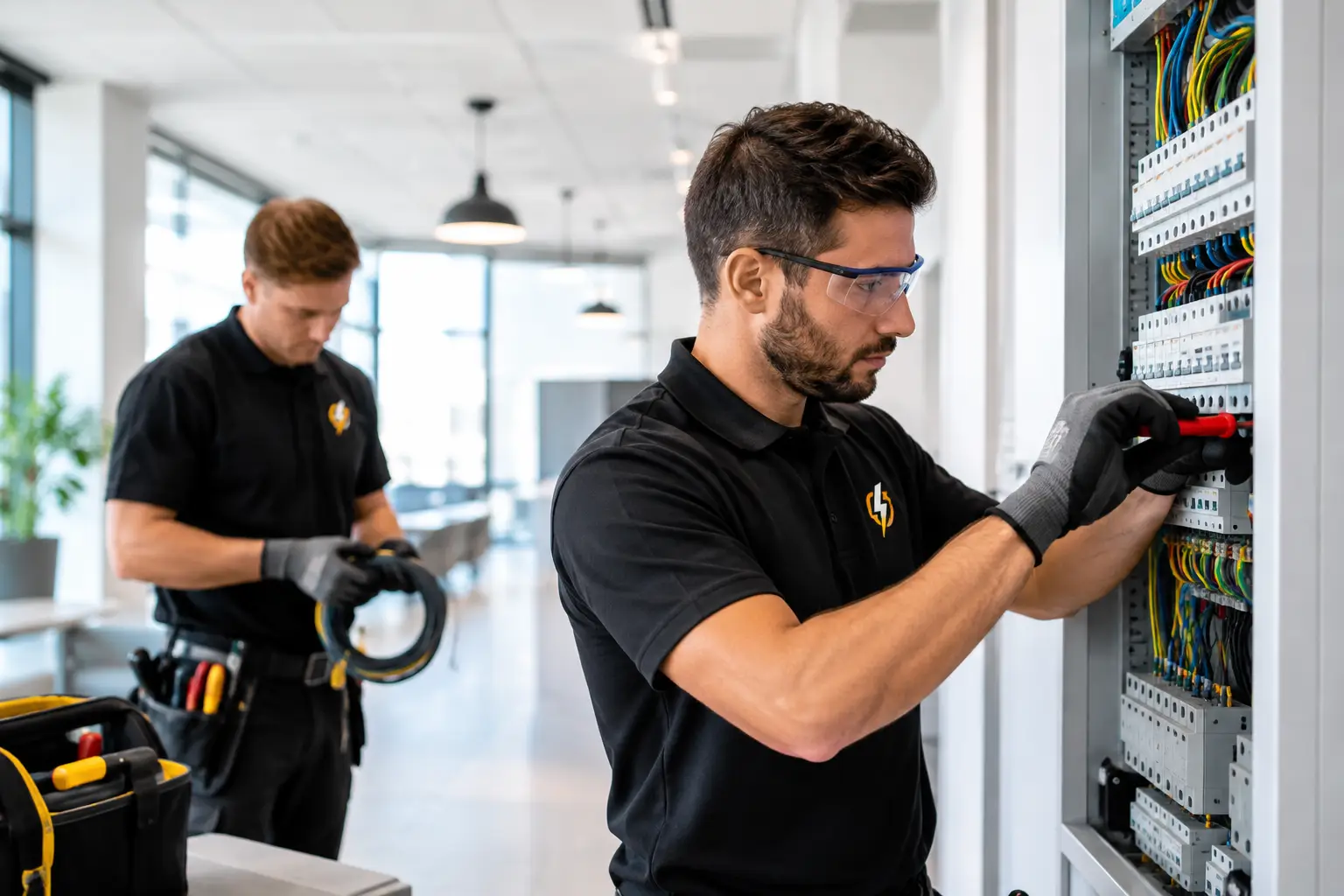
A tripping circuit, an overdue inspection report or a consumer unit that no longer suits the building should not be left to chance. Commercial electrical services help businesses, landlords and property managers keep premises safe, compliant and ready for day-to-day use, whether the requirement is a planned upgrade or a fault that is disrupting work.
For commercial properties in Bristol, Bath and Newport, the right contractor needs to do more than fit cables and accessories. They need to understand how the premises are used, complete work with minimal disruption where possible, and provide the certification that supports compliance, insurance and property records. NICEIC approved electricians provide the recognised competence and documented standards that responsible property stakeholders look for.
When commercial electrical work is needed
Electrical work is often prompted by a visible problem: sockets that are damaged, lighting that repeatedly fails, circuits that trip or equipment that cannot be used reliably. These issues need investigation, not guesswork. A recurring trip may relate to a faulty appliance, an overloaded circuit, deteriorated wiring or another issue within the installation. The cause should be identified before a repair is selected.
Planned work is just as important. Office refurbishments, retail fit-outs, changes of tenancy and equipment upgrades can all alter the demands placed on an electrical installation. A layout that worked for a small office may not suit added workstations, new heating or cooling equipment, commercial kitchen appliances, display lighting or EV charging.
Landlords and managing agents also need a clear record of the condition of electrical installations. In a commercial setting, a current inspection report can identify developing defects before they become a safety issue or lead to costly disruption. For occupied buildings, arranging works in stages can often be more practical than waiting until a fault forces an urgent response.
Commercial electrical services that support safe premises
The correct scope depends on the building, its age, the condition of the installation and the way it is used. A survey and clear quotation should establish what is necessary now, what may be sensible to plan for, and what certification will be issued when the work is complete.
EICRs and documented electrical condition
An Electrical Installation Condition Report, commonly known as an EICR, assesses the condition of the fixed electrical installation. It is not simply a check that lights come on. The inspection examines elements such as consumer units, protective devices, wiring, earthing and accessible accessories to identify damage, deterioration, defects or non-compliance that could affect safety.
The report records observations using recognised codes and states whether the installation is satisfactory or unsatisfactory. Where remedial work is needed, the report gives property owners and managers a clear basis for action. This is particularly useful for landlords, letting agents and businesses that need reliable documentation for their records, insurers or lease obligations.
Inspection intervals are not identical for every property. The appropriate timing can depend on the type of premises, the installation’s condition, how it is used and any previous findings. A busy workshop, retail unit and office may have different risks. An electrician can advise on a suitable inspection programme rather than applying a one-size-fits-all approach.
Consumer unit and fuse-board upgrades
Older fuse boards may not offer the level of protection expected in a modern commercial installation. A consumer unit upgrade can improve circuit protection and help bring an installation in line with current requirements, but it should not be treated as a standalone cosmetic change. The condition of the existing wiring, earthing arrangements and connected circuits must be considered first.
An upgrade may be appropriate where a board is outdated, damaged, overloaded or no longer suited to the property’s electrical demands. It can also form part of a wider refurbishment or rewire. If the wiring itself shows signs of deterioration, replacing the consumer unit alone may not resolve the underlying problem. A proper assessment avoids spending money on a partial solution that does not address safety.
Rewires, alterations and new installations
Commercial premises are regularly adapted for new occupiers, different layouts and changing services. This can involve additional sockets, data-related power provision, lighting alterations, new circuits for specialist equipment or electrical work for extensions and refurbishments.
A partial rewire may be suitable where a defined area needs upgrading and the remaining installation is in good condition. A full rewire is a larger undertaking and may be necessary when wiring is old, damaged, unsuitable or extensively altered over time. The practical choice depends on inspection findings, the building’s future plans and whether access can be arranged while the premises remain operational.
For occupied sites, good planning matters. Work can sometimes be scheduled around trading hours, staged by area or coordinated with other contractors. There are limits, particularly where safe isolation is required, but early discussion gives more options for reducing interruption.
Lighting, power and electrical repairs
Commercial lighting affects safety, customer experience and the ability of staff to work effectively. Failed fittings, poor illumination and unsuitable layouts can create avoidable problems, especially in entrances, stairwells, work areas and customer-facing spaces. Replacement or new lighting should suit the purpose of the area rather than simply match what was installed previously.
Power issues also deserve prompt attention. Loose sockets, damaged switches, overheating accessories and intermittent supply faults can worsen if they are ignored. A qualified electrician should test and diagnose the issue, explain the required repair and confirm when the installation is safe to return to use.
EV charger and solar electrical work
More businesses are considering workplace EV charging for staff, fleet vehicles and visitors. An EV charger installation needs more than a convenient parking space and a nearby supply. The existing electrical capacity, earthing, cable route, load management and charger location all need to be assessed. In some buildings, the supply can support the proposed charging points without major changes. In others, additional design work or an upgrade may be needed.
Solar-related electrical work also requires the installation to be considered as a complete system. The generation equipment, inverter arrangements, protective devices and connection to the property’s electrical installation must be correctly specified and installed. For a commercial property, the most suitable approach depends on site usage, available space and the intended demand profile, not just the size of the roof.
Choosing a commercial electrical contractor
Price matters, but a commercial quotation should be judged on more than the final figure. A very low estimate can leave important questions unanswered: whether testing is included, what materials are specified, how access and disruption will be managed, and which certificates will be supplied at completion.
Before appointing an electrician, it is sensible to confirm that they are appropriately accredited, insured and experienced in the type of work required. NICEIC approval gives businesses and property professionals confidence that the contractor works within an assessed framework and can provide the relevant certification. It is also worth checking that the quotation clearly sets out the scope, assumptions and any exclusions.
For larger or more complex projects, a site visit is usually more reliable than pricing from photographs alone. It allows the electrician to assess access routes, distribution equipment, visible installation condition and practical constraints. It also helps avoid variations caused by information that was not available at the quotation stage.
A practical approach for businesses and property managers
The most cost-effective electrical decision is rarely to wait until something fails. Keeping reports organised, acting on urgent EICR observations and planning upgrades around refurbishments or lease changes can reduce unplanned downtime. It also creates a clearer record for tenants, insurers, buyers and future contractors.
CRS Electrical provides domestic and commercial work across Bristol, Bath and Newport, including EICRs, rewires, consumer unit upgrades, repairs, EV charger installations and solar electrical work. A free quote gives property stakeholders a straightforward way to establish the likely scope before committing to works.
If an electrical issue is affecting the safety or operation of your premises, record what is happening, avoid using damaged equipment and arrange for a qualified electrician to assess it. A clear diagnosis and the right certification provide far more reassurance than a temporary fix.