
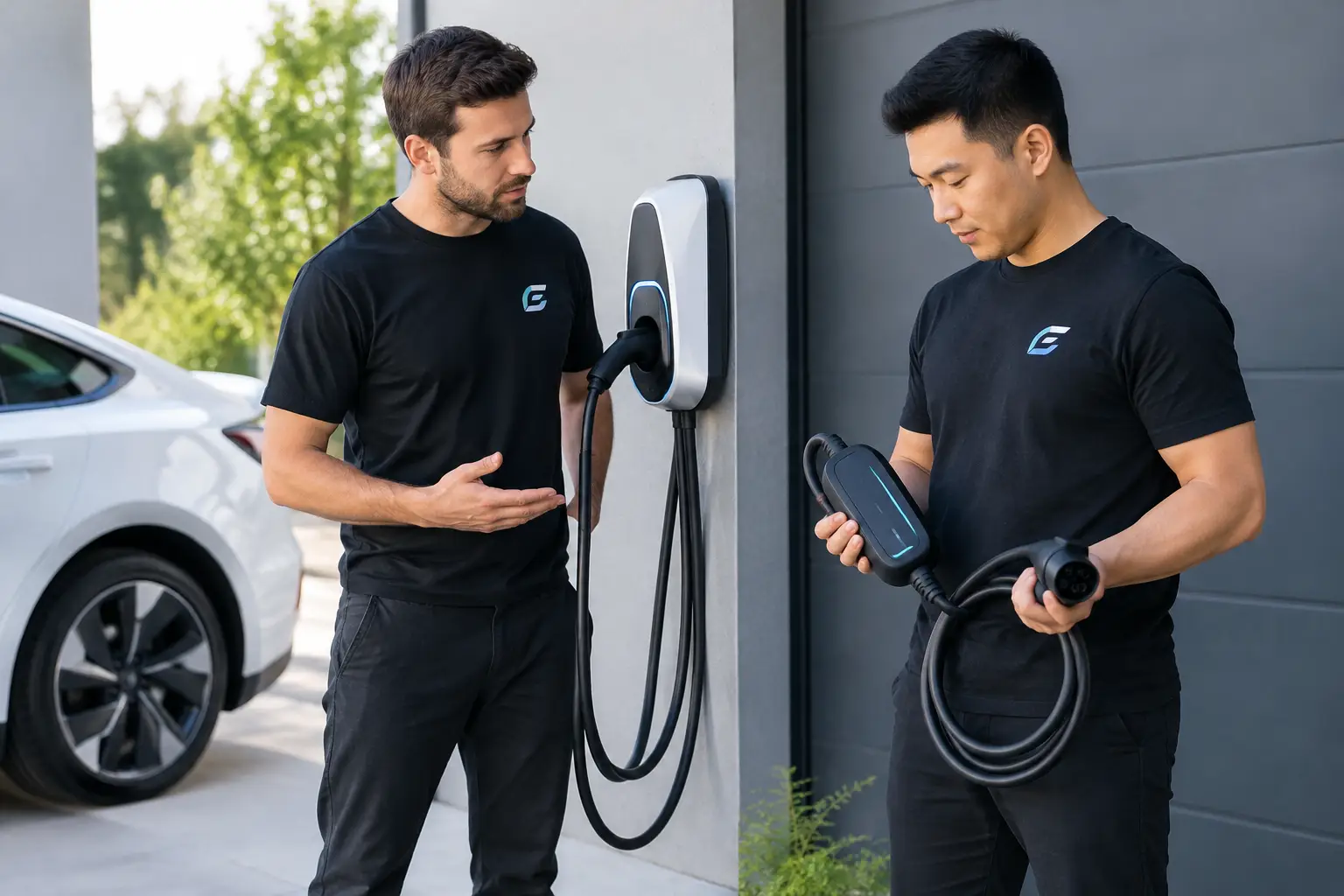
A home EV charger should make the school run, commute or first job of the day easier, not add another task to remember. When comparing EV tethered versus untethered chargers, the main difference is simple: a tethered unit has a charging lead permanently attached, while an untethered unit has a socket for a separate cable. The right choice depends on how you park, who uses the charger and how much flexibility you need.
Both types can provide reliable charging when correctly specified and installed by a qualified electrician. The charger itself is only part of the decision. Your property’s electrical supply, consumer unit, cable route, earthing arrangements and any existing high-load equipment all need proper consideration.
What is a tethered EV charger?
A tethered charger has its own fixed charging cable. You park, take the connector from the wall unit and plug it into the vehicle. Most domestic tethered chargers use a Type 2 connector, which suits the majority of modern electric cars sold in the UK.
For many homeowners, this is the most convenient option. The lead is always there, so there is no need to find a cable in the boot, untangle it in bad weather or remember to put it back after a journey. If the charger is installed close to your usual parking position, charging becomes a straightforward part of arriving home.
Tethered units can also be useful at workplaces where the same vehicle or a small number of familiar vehicles charge regularly. A clearly available lead can encourage use and reduce the risk of staff assuming they need to provide their own cable.
There are trade-offs. The cable is visible on the front of the property and, although it can be neatly stored on the unit, some customers prefer a less obvious installation. It is also more exposed to day-to-day handling. A damaged tethered cable may require professional replacement, whereas an untethered charger allows the cable alone to be changed.
When tethered charging makes most sense
A tethered charger is usually a strong choice where one household has one main EV, the driveway layout is fixed and convenience is the priority. It particularly suits drivers who charge most evenings or who do not want to handle a separate lead in rain, frost or darkness.
Cable length matters. A lead that is too short may not reach comfortably if the vehicle is parked in a different orientation. One that is excessively long can create unnecessary clutter and must never be left where it presents a trip hazard across a pavement or shared access route.
What is an untethered EV charger?
An untethered charger has a socket, normally Type 2, rather than a permanently connected cable. The driver plugs their own charging lead into the charger and then into the car. Once charging is complete, the cable can be removed and stored in the vehicle or indoors.
The clean appearance is a major reason to choose this type. With no cable hanging on the wall, an untethered charger can look more discreet on the outside of a house, block of flats, office or managed site. It may also be preferable where a charger is near a public-facing area and the property owner wants less equipment on display.
Flexibility is another benefit. Different charging cables can be used where suitable, and replacing a worn cable does not necessarily involve work on the charge point itself. This can appeal to landlords, property managers and businesses responsible for shared facilities.
The practical downside is that every driver needs access to a compatible cable. Most EV owners already carry one, but that is not guaranteed. At a workplace or rental property, an untethered charger may lead to questions over who supplies the cable, where it is kept and what happens if it goes missing.
When untethered charging makes most sense
An untethered charger can be the better option for a household that values a tidy frontage, has more than one EV or expects to change vehicles over time. It also works well for commercial premises where visitors, staff or tenants may bring their own cable.
It is often the sensible choice where the charger is installed for future use rather than a single current car. For example, a landlord preparing a property for EV-driving tenants may prefer a universal-looking socketed unit, provided the charging arrangement and responsibilities are clearly set out.
EV tethered versus untethered chargers: the key differences
The charging speed is not automatically determined by whether a charger is tethered or untethered. A correctly installed 7kW home charge point will typically offer similar charging performance in either format, subject to the vehicle’s onboard charging capability and the available supply. The important comparison is between the individual charger models and the electrical installation, not only the cable arrangement.
Convenience favours tethered units. For a driver returning to the same driveway each evening, having the lead ready to use saves time and small frustrations. Appearance and cable flexibility favour untethered units. A socketed charger leaves less visible equipment outside and lets users replace or upgrade their own lead where appropriate.
Security should be considered in both cases. Good-quality chargers include features such as locking mechanisms, access control or app controls, depending on the model. At shared commercial sites, restricting access can help prevent unauthorised electricity use. The cable itself should be stored securely and kept clear of walking routes.
For homeowners, the choice is often personal. For businesses and managed properties, it is more likely to involve usage rules, access arrangements, maintenance responsibility and the number of different vehicles expected to use the point.
Installation matters as much as the charger type
A charge point is a significant addition to a property’s electrical system. Before installation, an electrician should assess the incoming supply, the capacity of the existing consumer unit, the proposed cable route and the location of the charger. Properties with older electrical installations may need upgrades before an EV charger can be fitted safely.
The charger position needs thought too. It should be convenient for the vehicle without creating a cable hazard, vulnerable impact point or awkward route across the driveway. For a business, this may mean considering bay markings, bollard protection, signage and future expansion from the start.
Load management is particularly relevant where a property already has electric heating, a hot tub, solar equipment, battery storage or other substantial electrical demand. Some chargers can monitor household load and reduce charging output when necessary, helping to avoid overloading the supply. This is not a substitute for a proper assessment, but it can be a valuable part of a well-designed installation.
Electrical work should be completed to current requirements and tested properly. A NICEIC approved electrician can assess the installation, carry out the required work and provide the relevant certification. This matters for safety, insurance, property records and peace of mind.
Choosing for homes, landlords and businesses
For a typical homeowner in Bristol, Bath or Newport, choose a tethered charger if everyday ease is your priority and you have a predictable parking arrangement. Choose untethered if a discreet finish, removable cable or greater flexibility between users matters more.
Landlords and letting agents should consider who is expected to provide the charging cable, whether charging is for one allocated space or shared use, and how electricity costs are managed. A suitable installation should be planned around the tenancy arrangement rather than added as an afterthought.
Businesses should look beyond the first charger. A unit that serves a director’s vehicle today may become a staff benefit or visitor facility later. Selecting the right location, allowing capacity for additional points and putting clear charging rules in place can prevent expensive alterations later.
CRS Electrical provides EV charger installation for domestic and commercial properties across Bristol, Bath and Newport, with practical advice based on the property, vehicle use and existing electrical installation.
The best charger is the one that fits how the property is actually used. A short discussion about your parking routine, future vehicle plans and electrical capacity before work begins can turn a useful upgrade into a reliable long-term installation.