
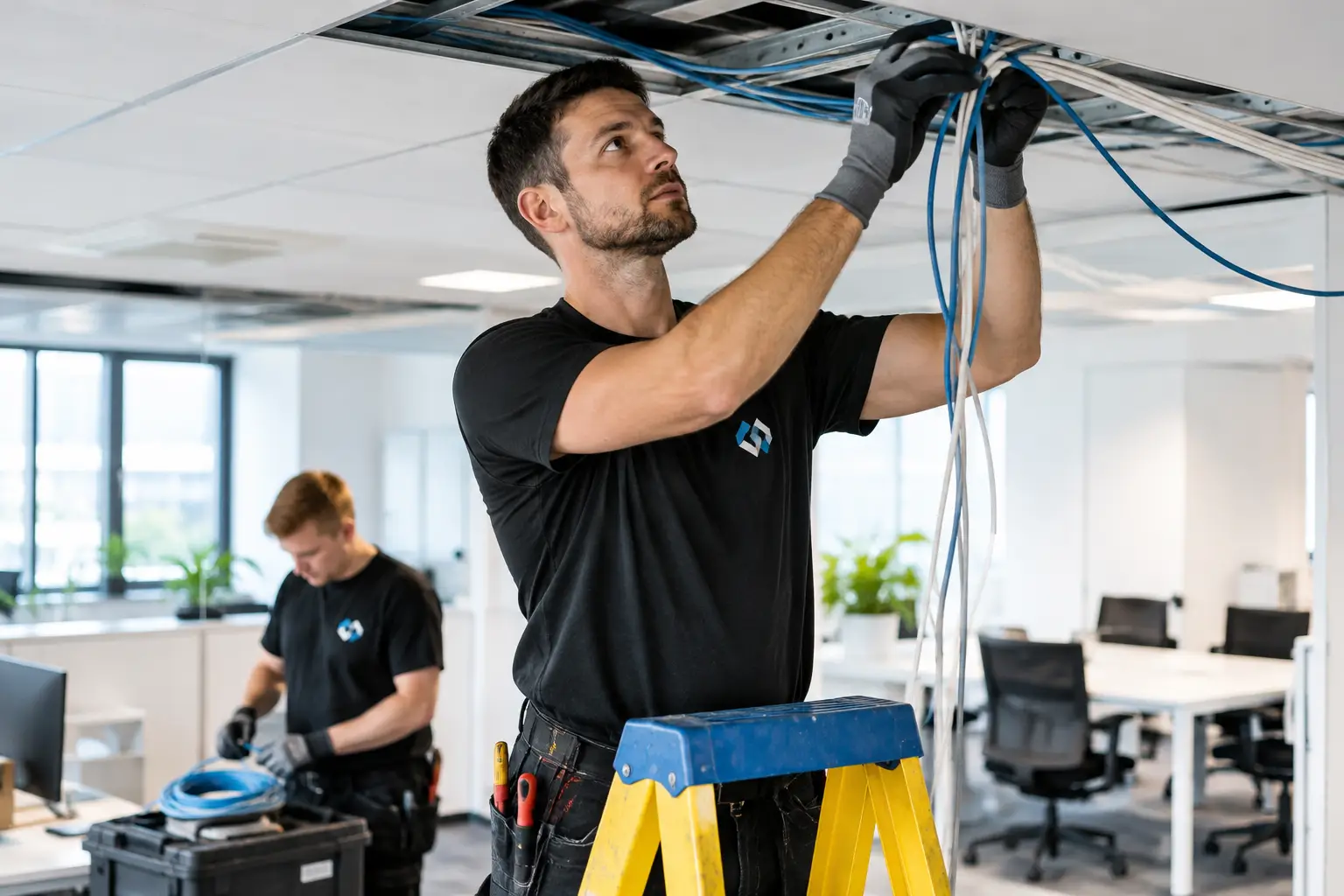
An office that has gradually accumulated extension leads, overloaded sockets and extra desk equipment is rarely set up for the way people now work. Office rewiring gives a business the opportunity to replace ageing electrical infrastructure, remove known risks and create a practical supply for current and future demands. For offices in Bristol, Bath and Newport, it is also a sensible point to address electrical compliance before a fault, failed inspection or disruption to trading forces the issue.
When does an office need rewiring?
Electrical installations do not always fail dramatically. More often, they become unsuitable over time. An office may have been designed for a handful of desktop computers but now supports dual screens, docking stations, printers, kitchen appliances, air conditioning, network equipment and EV charging. Even where the wiring is not immediately dangerous, an installation may no longer provide enough circuits, socket outlets or protection for safe day-to-day use.
Warning signs include regularly tripping circuits, warm or damaged sockets, flickering lights, buzzing from the consumer unit, exposed cables and a reliance on multi-way adaptors. Older fuse boards, particularly those without modern RCD protection, should also be assessed. These signs do not automatically mean a full rewire is required, but they do justify professional investigation.
The age of the building matters, although age alone is not the decision-maker. A well-maintained installation may need targeted upgrades rather than complete replacement. Conversely, wiring that has been altered repeatedly during previous fit-outs can require more extensive work, even in a relatively modern office. An Electrical Installation Condition Report, or EICR, provides a clear starting point by identifying defects, deterioration and areas that do not meet current safety standards.
What office rewiring involves
A full office rewire replaces the fixed electrical wiring and is normally planned around the layout and operation of the business. This can include new circuits, socket outlets, lighting supplies, switches, containment, data-related electrical provision and a new consumer unit or distribution board where required. The exact scope depends on the property, its existing installation and how the space will be used.
A partial rewire can be the better option where only a floor, extension, kitchen area or newly configured workspace needs upgrading. It may also suit a business refurbishing a tenancy while the remainder of the installation has been tested and found to be in satisfactory condition. The key is to avoid treating a partial solution as a shortcut when the condition of the wider installation suggests otherwise.
A proper survey should consider more than the number of desks. It should account for dedicated circuits for high-load equipment, emergency lighting where applicable, kitchen appliances, server or comms cupboards, ventilation, security systems and future expansion. Allowing capacity at the design stage is generally more cost-effective than reopening walls or flooring when another team moves in six months later.
Consumer units and circuit protection
The consumer unit is central to a safe electrical installation. Older boards may lack the protective devices expected in modern commercial environments, or they may have insufficient capacity for additional circuits. During a rewire, an electrician can specify appropriate circuit protection and label the installation clearly, helping staff and facilities managers identify what each circuit serves.
This is particularly useful in offices with separate areas, such as meeting rooms, kitchenettes, storage rooms and landlord-controlled supplies. Well-organised circuits can make fault finding quicker and reduce the risk that a minor issue takes down a larger part of the workplace.
Lighting, sockets and the working environment
Rewiring is a chance to improve how an office feels as well as how it functions. Poorly positioned sockets lead to trailing cables across walkways. Inadequate lighting can make screen work uncomfortable, create darker areas around storage or reception points, and increase energy use where inefficient fittings are still in place.
A new installation can place socket outlets where people actually work, including meeting tables and flexible desk areas. LED lighting upgrades may be included where appropriate, with zoning and controls to avoid lighting empty areas unnecessarily. The right approach depends on the working pattern: a small professional office has different needs from a busy managed building, shop office or multi-tenant premises.
Minimising disruption to your business
The main concern for many business owners is not whether rewiring is worthwhile, but how the work can happen without stopping operations. This is why planning matters. Before work begins, the electrician should understand access arrangements, operating hours, sensitive equipment, occupied areas and any deadlines linked to a lease, refit or reopening date.
Some office rewiring can be phased by room or floor, with work carried out outside normal hours where practical. In a major refurbishment, it is often most efficient to complete electrical work before final decoration, flooring and furniture installation. For an occupied office, temporary supplies or carefully planned shutdowns may be needed. These arrangements should be discussed in advance rather than assumed.
There is a trade-off. Working in phases can reduce day-to-day disruption, but it can take longer than completing a vacant space in one programme. The best route depends on the size of the office, the flexibility of the team and whether the existing installation can safely remain in service while work progresses.
Compliance, testing and certification
Commercial electrical work must be carried out competently and tested properly. Businesses also have duties to maintain electrical systems in a safe condition. For landlords, property managers and employers, documented inspection and certification are essential evidence that electrical safety has been addressed.
On completion of notifiable installation work, the relevant electrical certification should be provided. Testing confirms that circuits have been installed correctly and that protective measures operate as intended. Keep these records with EICRs, maintenance information and previous certificates. They are valuable for insurance, health and safety management, lease obligations and future alterations.
Using NICEIC approved electricians gives clients added reassurance that work is completed within a recognised competent person framework. It also helps ensure that the practical work, inspection, testing and certification are handled as part of the same professional service, rather than left as separate problems to resolve later.
Planning for EV charging and solar
Businesses increasingly want to provide workplace EV charging or make use of solar generation. Both can affect the capacity and design of the electrical installation. Installing chargers without understanding the existing load can create avoidable constraints, while solar electrical work needs to integrate safely with the building's supply and distribution arrangements.
If either upgrade is likely within the next few years, raise it during the rewire survey. Allowing for suitable routes, space in the distribution board and potential future circuits can make later installation more straightforward. It does not always mean fitting every element now, but it prevents short-term decisions from limiting sensible improvements later.
Choosing an electrician for office rewiring
Office electrical work is not simply a larger domestic job. It requires an understanding of operational continuity, commercial safety duties, testing requirements and the way different workspaces use power. Ask what is included in the quotation, whether testing and certification are covered, how disruption will be managed and what assumptions have been made about the existing installation.
A clear quotation should distinguish between essential remedial work, recommended improvements and optional future-proofing. That allows a business to make an informed budget decision rather than discovering necessary items after work has started. CRS Electrical provides NICEIC approved domestic and commercial electrical work across Bristol, Bath and Newport, with free quotes for planned upgrades and electrical safety work.
If your office has outgrown its current wiring, do not wait for repeated faults or an unsatisfactory EICR to dictate the timetable. A professional assessment can identify whether a full rewire, partial upgrade or consumer unit replacement is the most proportionate next step, giving your business a safer installation and a workplace better suited to the way it operates.