
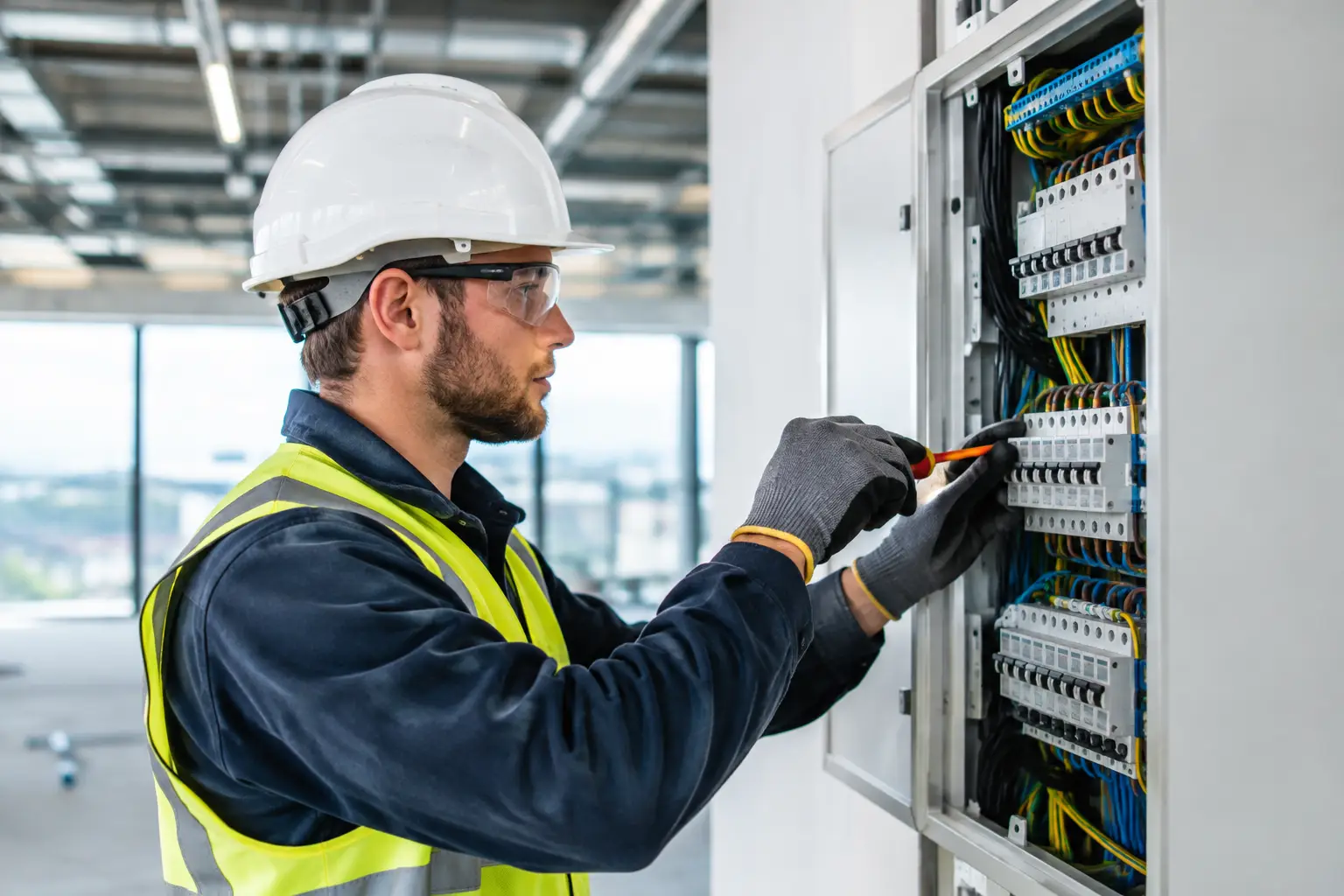
A failed light fitting in a shop, an overloaded circuit in an office or an expired Electrical Installation Condition Report can quickly become more than an inconvenience. What is commercial electrical work? It is the installation, alteration, testing, repair and maintenance of electrical systems in business and non-domestic premises, carried out to keep people safe, operations running and properties compliant.
For a business owner, landlord or property manager, the key difference is not simply the size of the building. Commercial work must suit how a premises is used, who has access to it and the risks created by its electrical installation. It also needs the right documentation, particularly where insurance, tenancy agreements, health and safety duties or future property transactions are involved.
What does commercial electrical work include?
Commercial electrical work covers a broad range of services in offices, shops, restaurants, warehouses, communal areas, workshops, schools, surgeries and managed properties. A small retail unit may need a new consumer unit and additional sockets for point-of-sale equipment. A larger office may require new distribution equipment, emergency lighting, data containment or a planned programme of periodic inspection.
The work can be straightforward, such as replacing a damaged socket, repairing a lighting circuit or fitting LED lighting. It can also form part of a larger project, including a full rewire, office refurbishment, change of use, extension or landlord fit-out. Electric vehicle charger installations and electrical work associated with solar panels are increasingly common for businesses planning to reduce running costs or support staff and customer travel.
A qualified commercial electrician will assess the condition and capacity of the existing installation before recommending a solution. Adding equipment to an already heavily loaded circuit, for example, may not be safe or practical without upgrading the distribution board, protective devices or cabling first.
Typical commercial electrical services
Most commercial projects fall into a few familiar categories: new electrical installations, alterations to existing circuits, fault finding and repairs, planned maintenance, testing and inspection, and electrical upgrades. The exact scope depends on the building and its use.
In a café, the priority may be safe power supplies for kitchen equipment and reliable lighting. In an office, it may be enough socket capacity, orderly cable routes and emergency lighting. In communal residential areas, landlords and managing agents may need safe lighting, fire alarm interfaces and current inspection records. The same electrical task can have very different requirements depending on the environment.
How commercial work differs from domestic electrical work
Domestic and commercial electrical work are built on the same essential principles: correct design, safe installation, suitable protection and proper testing. Commercial premises, however, often have more complex loads, greater public access and more demanding operational needs.
A business may rely on its electrical system for tills, refrigeration, machinery, IT equipment, security systems or essential lighting. A fault can interrupt trade, create safety concerns and lead to costly downtime. This is why commercial work should be planned around the way the premises operates, including trading hours, staff access and the need to keep parts of the building live while work is completed.
Commercial installations may also be subject to additional responsibilities under the Electricity at Work Regulations 1989. Duty holders must ensure electrical systems are maintained so far as reasonably practicable to prevent danger. That does not mean every building needs the same maintenance schedule. A quiet office and a busy workshop face different levels of wear, environmental exposure and risk, so the inspection frequency should reflect the installation and how it is used.
Electrical installation condition reports and compliance
An Electrical Installation Condition Report, commonly called an EICR, is one of the most important commercial electrical services. It is a formal inspection and test of the fixed wiring and associated electrical equipment within a property. The report identifies damage, deterioration, defects and departures from current safety standards that could affect the safe use of the installation.
An EICR is not a guarantee that every appliance in a workplace is safe, and it is not the same as portable appliance testing. It focuses on the fixed electrical installation: consumer units or distribution boards, wiring, sockets, switches, lighting circuits and earthing arrangements. If problems are found, the report will explain their severity and whether remedial work is required.
For commercial landlords, letting agents and facilities managers, an up-to-date EICR provides clear evidence that the electrical installation has been inspected by a competent person. It can support compliance processes, insurance requirements and property records. For business owners, it helps identify problems before they result in a serious fault or unplanned closure.
Electrical work should be designed, installed and verified in line with BS 7671, the Requirements for Electrical Installations. When work is complete, the appropriate electrical certificate should be issued. The certificate needed depends on the type and scale of work, so it is sensible to confirm this before a project begins rather than assume that a receipt alone is sufficient.
When should a business call a commercial electrician?
Some issues need prompt attention. Repeated tripping, burning smells, hot sockets, flickering lights, electric shocks, exposed cables and water damage near electrical equipment should never be ignored. Switch off the affected circuit where it is safe to do so, keep people away from the area and arrange for a qualified electrician to investigate.
Other jobs benefit from early planning. If you are taking on a new lease, refurbishing a unit, installing new equipment or changing the layout of a workspace, involve an electrician before walls are closed or furniture and machinery are in place. Early assessment can reveal whether the current supply has enough capacity and whether new circuits, upgraded protection or containment will be needed.
This is particularly relevant for EV chargers, commercial kitchen equipment, air conditioning, heat pumps and solar-related electrical work. These additions can place significant demand on an installation. The right answer may be a simple dedicated circuit, but older or undersized installations can require wider upgrading.
Why NICEIC approval matters for commercial premises
Commercial property decisions often involve more than one party. A tenant may need landlord consent, a managing agent may need clear records and an insurer may ask for evidence of inspection or remedial work. Choosing a NICEIC-approved electrician gives customers confidence that work is being completed by a contractor assessed against recognised technical and safety standards.
NICEIC approval is especially valuable where certification is required. It demonstrates that the contractor is part of a recognised competent person scheme and works within an assessed framework. It does not remove the need for a proper survey or make every project identical, but it is a meaningful safeguard when selecting an electrician for business-critical work.
For customers in Bristol, Bath and Newport, local attendance also matters. A contractor who understands the area can provide practical support for occupied premises, planned upgrades and ongoing maintenance, without treating a commercial job as a one-off transaction.
Planning commercial electrical work with minimal disruption
A clear quotation should set out what is included, what assumptions have been made and whether testing, certification, making good or out-of-hours working are required. The cheapest quotation is not always the best value if it excludes essential remedial work, certification or the time needed to complete the job safely around staff and customers.
Before work starts, consider access arrangements, trading hours, isolation requirements and any sensitive equipment that could be affected by a power shutdown. In some premises, work can be phased room by room or completed outside normal hours. In others, a planned isolation is safer and more efficient. The right approach depends on the installation and the business, not a standard template.
CRS Electrical provides NICEIC-approved domestic and commercial electrical work across Bristol, Bath and Newport, including EICRs, rewires, consumer unit upgrades, EV chargers, solar electrical work and general repairs. A free quote gives you the opportunity to discuss the property, the intended use and the certification needed before work is booked.
A well-maintained electrical installation should not be something you only think about when it fails. Whether you are preparing a commercial unit for a new tenant, responding to an EICR or planning an upgrade, getting qualified advice early helps protect the people who use the building and keeps your premises ready for business.