
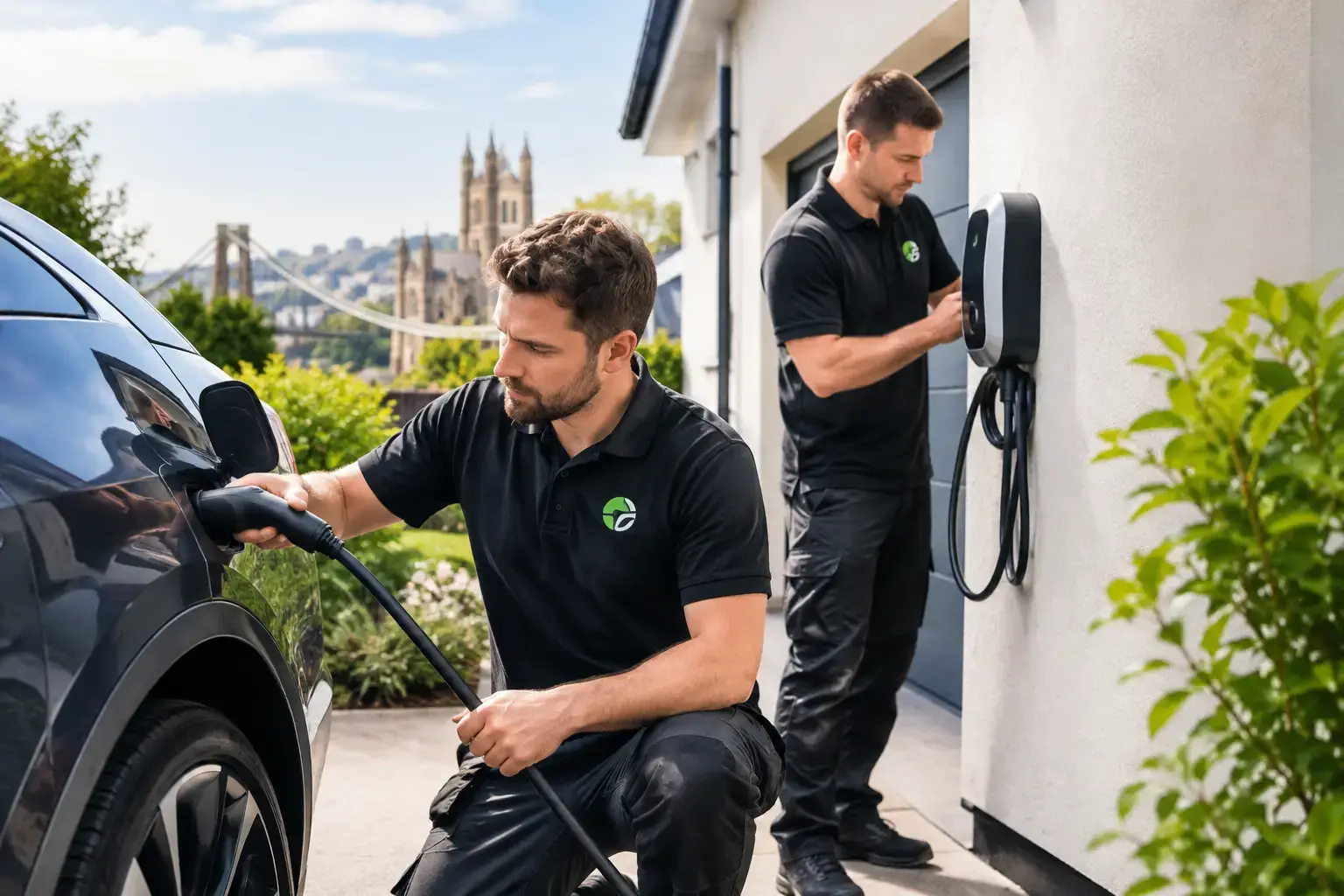
A home EV charging guide should start with the part that affects your daily routine: where the car is parked. A properly installed charge point lets you plug in when you return home and wake up to useful range, without relying on public chargers or running an extension lead through a window. For homeowners across Bristol, Bath and Newport, the right solution depends on the property’s electrical supply, parking arrangement and the way the vehicle is used.
Home charging is usually the most convenient and cost-effective way to run an electric vehicle. It also involves more than choosing a charger from a brochure. The existing consumer unit, earthing arrangement, cable route and available electrical capacity all need professional consideration before installation begins.
Why a dedicated home EV charger is the safer choice
A standard three-pin socket can add some charge to an EV, but it is not normally the best long-term arrangement. Charging a vehicle places a sustained electrical load on the circuit for several hours. Older sockets, unsuitable circuits and temporary extension leads can overheat or become damaged.
A dedicated EV charge point is designed for that job. It is installed on its own circuit, with the correct protective devices and cable size for the load. It can also provide faster charging than a three-pin plug, while smart features allow charging to be scheduled around the household routine or an off-peak electricity tariff.
For many homes, a 7 kW unit is a practical option. It will generally replenish a typical EV overnight, although actual times depend on the vehicle battery, its onboard charger, the state of charge and any limits set by the car. A 3.6 kW charger may suit some properties where electrical capacity is more restricted or driving mileage is lower. Faster is not automatically better if it requires costly supply alterations that do not match how the car is used.
Home EV charging guide: what an electrician checks
An EV charger should not be fitted as an isolated accessory. It becomes part of the property’s electrical installation, so a site survey matters. A NICEIC approved electrician will assess the installation and specify a charge point that is safe, compliant and suitable for the home.
Your consumer unit and electrical capacity
The consumer unit, sometimes called a fuse board, must have enough room and capacity for a dedicated circuit. Modern installations may only need an additional protective device and correctly installed cabling. Older fuse boards, rewireable fuses or signs of deterioration can mean an upgrade should be considered first.
The wider electrical load is equally important. An EV charger may operate while the oven, electric shower, heat pump, immersion heater or other high-demand appliances are in use. Load management can be used in some installations to monitor demand and temporarily reduce charging output rather than overload the supply. This can avoid unnecessary disruption while keeping the installation within safe limits.
Your Distribution Network Operator may need to be notified about the new load, or consulted before higher-capacity charging is installed. A qualified installer can manage the relevant process and explain any limitations identified during the survey.
Earthing and protective measures
EV charging requires specific safety arrangements. In particular, the property’s earthing system must be assessed, as some supplies need additional protection against faults outside the property. The charger, cable and protective devices must work together correctly.
This is not an area for guesswork or DIY installation. The work should be designed, installed, tested and certified by a competent electrician. Proper certification provides a record of the work and is useful for property files, future sales, landlords and insurers.
The route from the house to the parking space
The shortest cable route is often preferred, but it must also be practical and protected. An electrician will consider where cabling can run internally or externally, where it may need mechanical protection, and how it reaches the charger without creating an unsightly or vulnerable installation.
The charger should be positioned so that the vehicle’s lead reaches the charging port without crossing a public pavement, shared accessway or pedestrian route. Cables across paths create a trip hazard and may cause problems with neighbours, visitors or local access. Driveway parking is generally straightforward; on-street parking requires a more careful assessment and is not suitable for every property.
Choosing the right charge point
Most current charge points offer smart controls. These allow you to set charging times, monitor energy use and, in some cases, respond automatically to lower-cost tariff periods. A smart charger can be worthwhile if the car is usually home overnight and the household is on a tariff with cheaper off-peak electricity.
However, the app is not the main decision. Prioritise a reliable unit that suits the property, vehicle and charging habits. Consider whether you want a tethered cable permanently attached to the unit or an untethered socket that uses the cable supplied with the car. A tethered unit is convenient for daily use, while an untethered design may look neater and can be useful where different vehicles are charged.
Think ahead as well. If a second EV is likely within a few years, it may be sensible to allow for future cabling, a larger enclosure or load balancing from the outset. This is particularly useful during an extension, renovation or consumer unit replacement, when access is already available and disruption can be reduced.
Solar panels, batteries and EV charging
An EV charger can form part of a wider electrification plan. Households with solar panels may want the charger to use surplus generation where possible. This can make good use of electricity produced during the day, although it depends on when the vehicle is at home and how much solar power is available.
A battery storage system can add another layer of control, but it does not always reduce charging costs in the way homeowners expect. The right approach depends on your tariff, solar output, household consumption and vehicle mileage. An electrician can ensure that the EV charging equipment and solar electrical work are safely coordinated, rather than treating them as separate additions.
Flats, rented homes and shared parking
Home charging can be more complex for flats, leasehold properties and rental homes. Permission may be required from a landlord, freeholder or managing agent before works are carried out. Shared parking areas also raise questions about cable routes, ownership, metering and future access for other residents.
Landlords and property managers should think beyond one installation. A well-planned approach can allow for future demand without repeated disruption to communal areas or the building supply. Clear documentation, inspection and certification are especially valuable where several parties are responsible for the property.
For tenants, do not arrange alterations without written permission. A charge point can be a valuable improvement, but the installation must be agreed, appropriately designed and recorded.
Preparing for an EV charger survey
A good survey is quicker when the electrician can see the parking space, consumer unit and likely cable route. If possible, have details of the vehicle, proposed charger location and your electricity tariff available. It is also useful to mention planned solar panels, a heat pump, an electric shower, an extension or any known electrical issues.
Photographs can help with an initial quotation, but a site visit may still be needed where access is difficult, the property is older or the electrical installation needs closer inspection. In Bristol, Bath and Newport, housing ranges from newer developments to period properties with later alterations, so the scope should be based on the condition of the actual installation rather than assumptions.
CRS Electrical provides NICEIC approved domestic and commercial electrical work, including EV charger installation, consumer unit upgrades and the testing needed to keep property improvements safe and properly documented.
The best home charging installation is the one that feels simple every evening because the safety and planning were dealt with properly at the start. Before choosing a charger on price alone, arrange a professional assessment of your supply, parking and future electrical needs.